
Cases /
JFE Steel x Tokyo Bay: "Water Quality Improvement"
Tokyo Bay eSG Project, FY2022 priority project "Water Quality Improvement" / Lead: Innoqua / Partner: JFE Steel
A case that checked whether JFE Steel’s slag could help improve water quality in a part of Tokyo Bay where sludge has built up.
What we worked on together
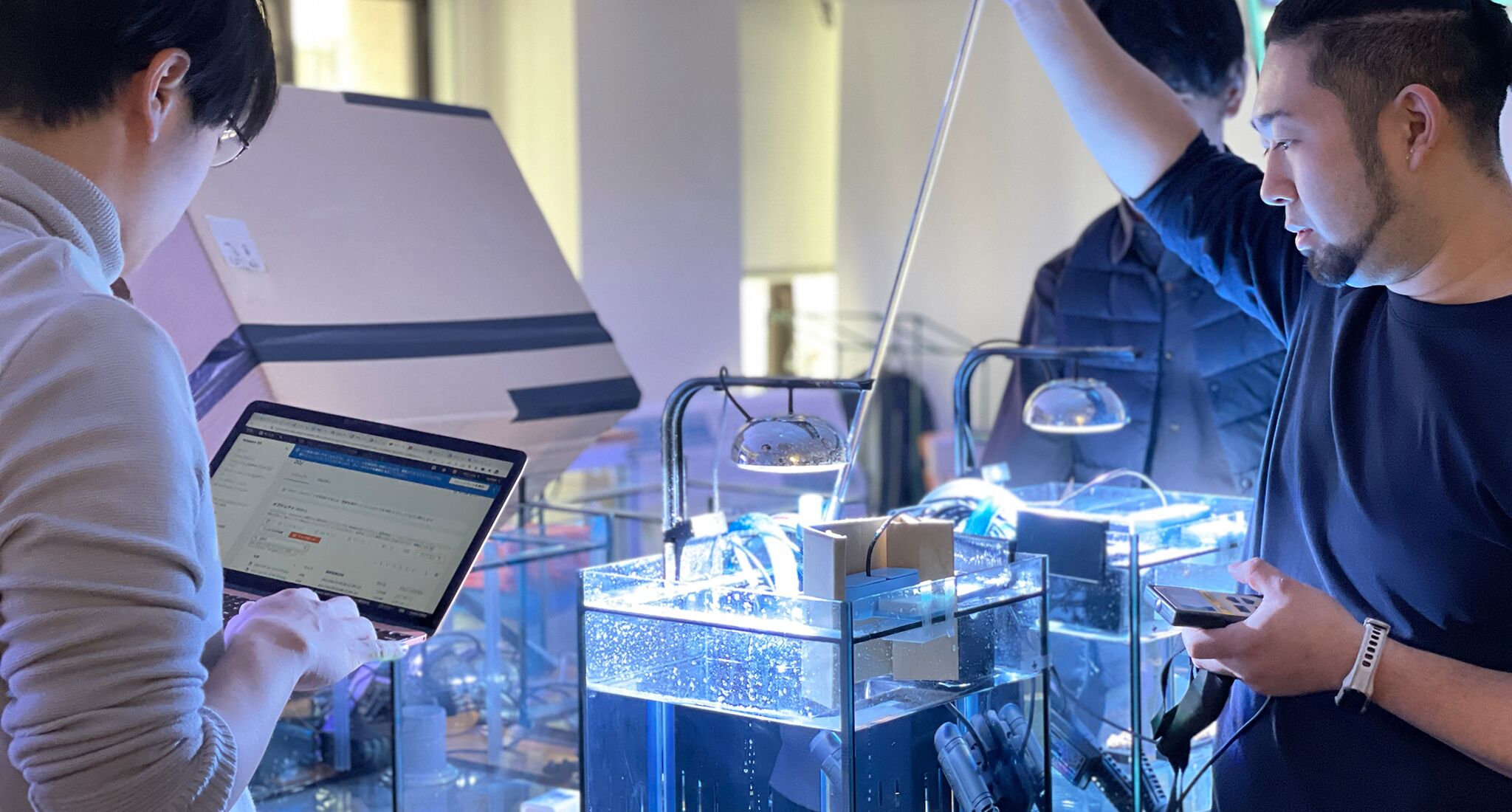
We set up an experimental tank recreating Tokyo Bay from its current, temperature, light and water-quality data, and tested the slag there. In November 2023, 500kg of slag was placed near Rinkai Chuo Bridge to check in the real sea.
Reproduction-accuracy comparison
| Field | Recreated tank | |
|---|---|---|
| Water temperature | 9.9–10.2℃ | 9–11℃ |
| Salinity | 31.7psu | 33psu |
| DO (dissolved oxygen) | 8.7–9.2mg/l | 8.14–10mg/l |
| Current speed | 0.3–2.5cm/s | 1–2cm/s |
What the experiments backed up
- In the recreated tank, hydrogen sulfide generation in the section with added small slag was suppressed to roughly half the control.
- Sulfur was detected on the surface of the recovered slag, suggesting it was adsorbing it.
- Small slag showed a "slight" effect suppressing mud resuspension (higher light transmittance than the control).
- The results from the recreated tank and the real sea area are described as matching.
- Next, the plan is to move to a more open-water demonstration suited to eelgrass-bed creation, aiming for social implementation from FY2030 onward.
Talk to us about environmental impact assessment and experiment design
This opens your mail app. Nothing is sent until you send it.